
Share:
How to Match Upgrade Sets to Your Model Kit (02.09.26)
A cockpit set labeled 1/48 is not automatically right for every 1/48 aircraft kit. The same applies to armor tracks, ship railings, replacement wheels, decals, masks, and conversion parts. Learning how to match upgrade sets begins with treating the base kit as a specific product, not simply a subject in a particular scale.
Aftermarket parts can transform an ordinary build, but they can also create needless work when the kit version, tooling, or production standard does not match. Before adding anything to the bench, identify exactly what you are building and decide which areas genuinely deserve the extra effort.
Start With the Exact Base Kit
The manufacturer name, scale, kit number, and tooling generation are the first checks. Record them before shopping. A detail set may be designed for a particular kit number because fuselage dimensions, cockpit tub shape, landing gear mounting points, or surface detail differ between manufacturers - and sometimes between reissues from the same manufacturer.
A 1/72 Bf 109 cockpit, for example, cannot be assumed to fit every Bf 109 kit. One kit may have a deep cockpit opening and separate sidewalls, while another has a shallow tub molded around a different fuselage profile. The subject and scale are only the starting point.
Product descriptions that state “for” a specific manufacturer and kit are the strongest fit indication. “Suitable for” or “universal” can still be useful, but expect measuring, trimming, or scratchbuilding. If a set names a kit that is close but not identical to yours, compare instructions and sprue layouts before committing.
Check the Tooling, Not Just the Box Art
Box art changes more often than molds. A reissue may use the original plastic with new decals, or it may contain revised parts from a later tool. Conversely, two boxes with similar artwork may hold entirely different kits.
Look at the kit number, release information, and instruction sheet. Pay particular attention to optional parts, alternate noses, turrets, engine decks, road wheels, or wing panels. These details often reveal whether an aftermarket item will fit without modification.
For older kits, replacement parts may be designed to correct an inaccurate shape rather than fit perfectly. That can be worthwhile, but it is a different project from a simple detail upgrade. Plan for cutting, filling, and careful alignment.
How to Match Upgrade Sets by Scale and Subject Version
Scale must match exactly. A 1/35 stowage set is not interchangeable with 1/48, even when the item looks small enough to adapt. Differences become especially obvious with crew figures, seat belts, ammunition, antenna bases, railings, and lettering on decals.
Subject version is equally critical. Military aircraft and vehicles often changed throughout production, while ships could appear very different after refits. A set for an early production vehicle may include the wrong mantlet, exhaust arrangement, cupola, or wheels for a later machine. An aircraft detail set may represent a cockpit before a radio update or an airframe before a major antenna change.
Use the kit instructions to establish the intended variant, then compare the set’s stated version. If you are modeling a specific aircraft, vehicle, or ship at a known date, reference photos should guide the purchase. Do not buy an upgrade only because it is marketed for the general type.
Decals require the same discipline. Confirm the unit, time period, camouflage scheme, and airframe or vehicle configuration. A decal sheet may be accurate, beautifully printed, and still unsuitable for the exhausts, antennas, national markings, or paint colors in your planned subject.
Match the Set to Your Build Goal
Not every model needs every available accessory. The best selection depends on whether you want a fast, clean build, a contest-level project, or a historically specific replica.
For a closed-canopy aircraft, a full resin cockpit may offer little visible return unless the kit interior is notably poor. In that case, a set of harnesses, instrument decals, or a colored photoetched panel may produce a better result for less work. With an open canopy, the cockpit becomes a focal point, and the investment makes more sense.
On armor, metal barrels and replacement tracks can change the appearance dramatically, but both demand alignment and planning. Individual-link tracks offer realistic sag and detail, while link-and-length tracks are generally faster and easier to keep straight. Neither is automatically the better choice.
For ships, photoetched railings, ladders, cranes, and radars add scale finesse that plastic parts rarely reproduce. They also require good folding tools, a controlled adhesive method, and patience. If photoetch is new to you, start with a focused set rather than a full replacement package for the entire model.
A practical upgrade plan usually concentrates on the most visible or weakest kit areas: cockpit, landing gear, gun barrels, wheels, tracks, exterior details, markings, or clear-part masks. Buying every available set can turn a straightforward build into a stalled project.
Understand What Each Material Demands
Aftermarket sets are not interchangeable in the way they are installed. Resin parts often provide the sharpest casting detail, but they need washing, careful removal from casting blocks, and cyanoacrylate adhesive. Dry-fit resin components repeatedly, especially cockpits, wheel bays, replacement noses, and engine sections. A fraction of a millimeter can prevent fuselage halves from closing.
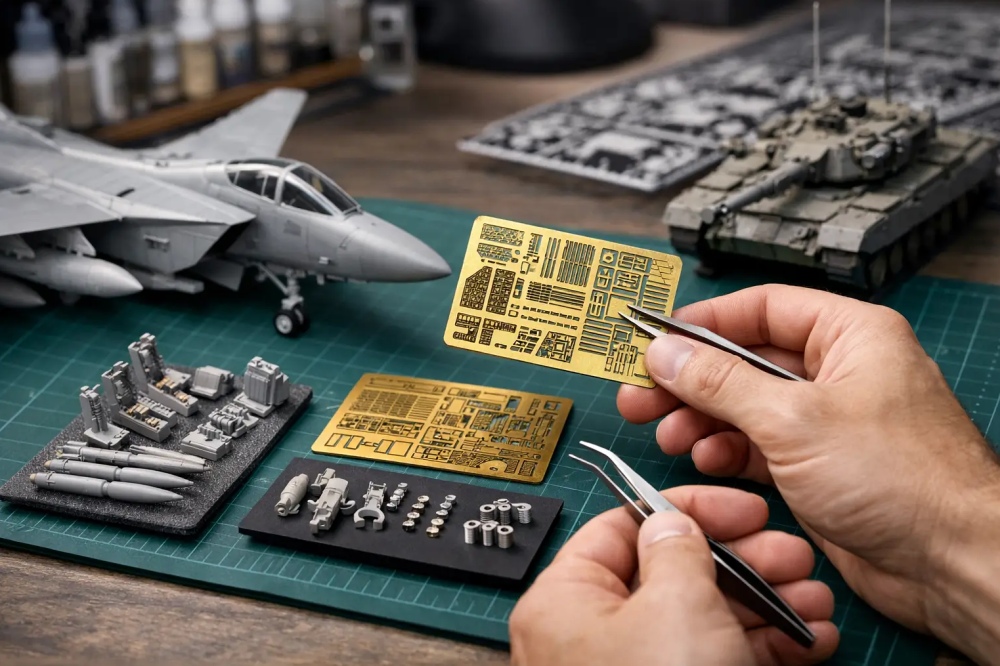
Photoetched brass is thin enough to represent scale metal, but it is unforgiving. It may require bending, annealing, soldering, or precise use of cyanoacrylate. Remove molded-on kit detail only when the instructions clearly call for it. Once plastic detail is removed, reversing the decision is difficult.
Turned metal barrels, pitot tubes, and antennas generally install easily, provided the mounting hole is centered. Drill gradually and test the fit. They are often a high-value upgrade because they improve thin, prominent parts without forcing major surgery.
Decals and paint masks need a different check: dimensions. National insignia, codes, walkway markings, canopy frames, and wheel hub masks must fit the kit’s actual surface area. A mask labeled for a certain kit is preferable to a generic set, particularly where canopy framing varies between toolings.
Read Instructions Before Buying, Not After
Many fit problems are visible in the aftermarket instructions. Look for parts that must be removed, holes that must be opened, panels that must be cut out, or kit components that are replaced. A conversion set may require extensive modification that is not obvious from a product photo.
Check whether the upgrade depends on another item. Some cockpit sets need a separate canopy, seat, or instrument panel. Some correction sets require a specific donor kit. Other products combine several improvements but overlap with items already in your cart.
Avoid duplicate solutions unless you have a clear reason. A full interior set and a separate seat-belt set may include the same harnesses. A brass exterior set may already supply landing gear doors or grilles that appear in another detail package. Read the contents carefully and spend the budget where it adds something new.
When building a cart at MODELIMEX, organize items around the exact kit first, then filter by scale, subject, and product type. This approach is faster than browsing by brand alone, and it reduces the risk of mixing parts intended for different toolings.
Plan the Order of Work
The right set can still cause problems if it is introduced too late. Decide on major corrections and resin interiors before assembling the kit. Test fit the fuselage, hull, or turret while access is still open. Install photoetched interior pieces before closing the model, and consider painting sequences before attaching fragile exterior brass.
Masks and decals belong in the planning stage as well. A canopy mask may affect whether you paint the interior frame color first. A complex decal sheet may require a gloss finish, a particular camouflage layout, or removal of kit-supplied raised detail. Knowing this before primer saves rework.
Keep the kit instructions, aftermarket instructions, and reference photos together. Mark conflicts directly on the instructions. This simple habit is especially useful when combining a resin set, photoetch, decals, and replacement wheels on one project.
When an Imperfect Match Is Still Worth It
A near-match can be a sensible purchase when the modification is minor and the improvement is visible. Generic seat belts, fine wire antennas, stowage, tie-downs, and some external accessories are often adaptable. The decision depends on your comfort with fitting work and whether the part’s dimensions are believable in scale.
Be more cautious with cockpits, canopies, conversion fuselages, wheel bays, replacement hulls, and large decal markings. These components define the model’s fit or identity, so a kit-specific match matters far more.
The most satisfying upgrade is not always the most comprehensive one. Choose sets that fit your exact kit, your chosen version, and the amount of work you want to put into the build. That leaves more time for clean assembly, convincing paintwork, and the details that will actually be seen.
(This article was created by AI)